The Enduring Legacy of Frogs
Frog Motifs Throughout Rolly Crump’s Career
Frogs have consistently appeared as a motif throughout Rolly Crump’s distinguished career, featuring in numerous notable projects. From their appearances in It’s a Small World to their inclusion in Bear-y Tales, and even within conceptual designs for Epcot’s unrealized Life Pavilion, Crump regularly integrated these dynamic amphibians into his work.
Evolution of Frog Concepts in Bear-y Tales
Drawing on his initial frog concepts developed for It’s a Small World, Crump applied similar creative elements to Bear-y Tales. During the design phase of this celebrated attraction, the Frog Forest remained a constant feature, ultimately establishing itself as an integral component that shaped the ride’s enchanting atmosphere.
Visual Humor and Iconic Status
Crump’s characteristic creativity and expertise in visual humor contributed significantly to the charm of the frogs depicted in Bear-y Tales. These distinctive figures became emblematic of the attraction, captivating audiences across generations and enhancing its unique environment.
Diverse Frog Characters and Their Lasting Influence
The diverse troupe of frogs introduced in Bear-y Tales augmented the character and vibrancy of the attraction, ranging from energetic performers and adept acrobats to the memorable Bing Frogsby, known for serenading his love with his banjo. Their animated presence permeated the entire experience, enriching the whimsical nature of the story and solidifying their role as treasured icons.
Adaptations and Preservation of Frog Figures
Elements of the original Frog Forest were later adapted for the Bear-y Tales Playhouse; however, the frogs inhabiting Toadville showed evident signs of extensive use. Over time, their spring-mounted bead pupils were replaced first by glued eyes and subsequently by doll eyes, altering the expressions and overall appearance of the characters. Frequent handling led to detached limbs and missing fingers, occasionally resulting in pieces becoming keepsakes among park visitors. Despite such wear, the large quantity of frogs produced ensured many were preserved, often through the efforts of employees who retained them following the closure of both venues.
Lasting Impact and Continued Appeal
The straightforward yet cheerful design of these frog figures left a lasting impact on park visitors, ultimately becoming enduring symbols of the attraction’s whimsical essence. Their sustained appeal led to their reintroduction in the newest attraction, maintaining their original aesthetic and continuing to engage new generations of guests with their recognizable charm.

“Ribbert”
by Phineas Huckleberry

"Ribbert," an original frog figure from Knott's Bear-y Tales, is a cherished relic of the park's whimsical past. Likely a static figure, Ribbert's exact role in the ride remains a mystery, though several photos from Toadville feature similar frogs, hinting at his possible origins. Over the years, Ribbert has endured the wear and tear of time, especially during the 1980s and 1990s when neglect took its toll. Now, at 50 years old, Ribbert is finally receiving the restoration he deserves, bringing a wave of nostalgia and excitement to fans of the classic ride.
The frogs from Knott's Bear-y Tales have become iconic symbols of the ride, and owning one is a rare and cherished opportunity. Ribbert, in particular, holds a special place in my heart as he was gifted to me, making him even more precious. Despite having only one vivid memory of the attraction, the frogs have become a core part of my childhood playhouse memories. Their whimsical presence and charming design left an indelible mark on my imagination, making Ribbert's restoration a deeply personal and meaningful project.
The restoration process has been a meticulous endeavor, aimed at investigating his construction and addressing the issues caused by decades of neglect. Using knowledge from hours of research into art conservation, each step utilizes techniques to protect as much of the original condition underneath the new work. This project not only honors the legacy of Knott's Bear-y Tales but also serves as a testament to the enduring appeal of classic theme park attractions. As Ribbert is restored to his former glory, he promises to enchant and delight a new generation of fans, preserving the magic of Knott's Berry Farm’s “Old Time Adventure” for years to come.
Repairing Right Hand: The restoration process began with an assessment of Ribbert’s right hand, which was missing a finger and had another finger detached. To reconstruct the missing finger, a wire hanger matching the original gauge was cut to the same length as the detached finger, ensuring consistency in appearance and structure. For the bead replacement, although a 12mm wooden bead with a 2.5mm hole was unavailable, a 10mm plastic bead was substituted. The bead’s hole was carefully drilled to accommodate the wire.
Examining the Left Hand: Attention then shifted to Ribbert’s left hand. A crude wrist cuff and webbing were removed, as they served no practical purpose; these pieces were stored for provenance. Beneath these, a 1/4-inch layer of grey compound was discovered but found to have no functional value, so it was removed to restore the original surface. The next step involved investigating how the fingers were attached to the hand, which provided valuable insight for the restoration.
Armature Investigation: The armature was straightened, revealing a connection loop just below the elbow joint. Beads were removed, and finger wires were straightened, allowing the connection loop to be pulled from the forearm. On the opposite side, a hand armature was attached—formed by a wire loop and the middle finger, with two smaller wire lengths welded to complete the structure.
Cleaning and Reattachment: This procedure was repeated for the other hand, with all wires cleaned using a bristle brush to remove rust. Both original and newly created fingers were reattached by wrapping them with thin jewelry wire to minimize bulk. The hand armature was reinserted through the forearm and reconnected to the main armature. Final adjustments involved bending the fingers back into their original shape and affixing beads to complete the restoration.


Removing Ribbert’s Eyes: The eyes were carefully extracted from Ribbert's head, where they had been secured with hot glue. Removing the glue was necessary to proceed with the restoration.
Restoration Process: To restore Ribbert’s eyes to their original 1975 state, two matching pen springs were sourced for their appropriate size and flexibility. These springs were trimmed to the needed length, leaving a straight end for secure attachment beneath the eye screw.
Restoring the Pupils: The pupil beads, previously held on the upper edge of the eye piece with hot glue, were detached and meticulously cleaned, along with the eye pieces, to remove glue build-up. The cleaned pupil beads were then glued to the end of the springs, faithfully recreating Ribbert’s original look.




Stabilizing Paint and Preparing Ribbert's Body: A layer of varnish was applied over Ribbert’s body to stabilize the original paint and ensure any new paint could be safely removed in the future if necessary. Areas with significant paint loss were filled with a compound to create an even surface. Once set, a primer was applied and layers of thinned neon paint were built up gradually, restoring Ribbert’s vibrant colors.
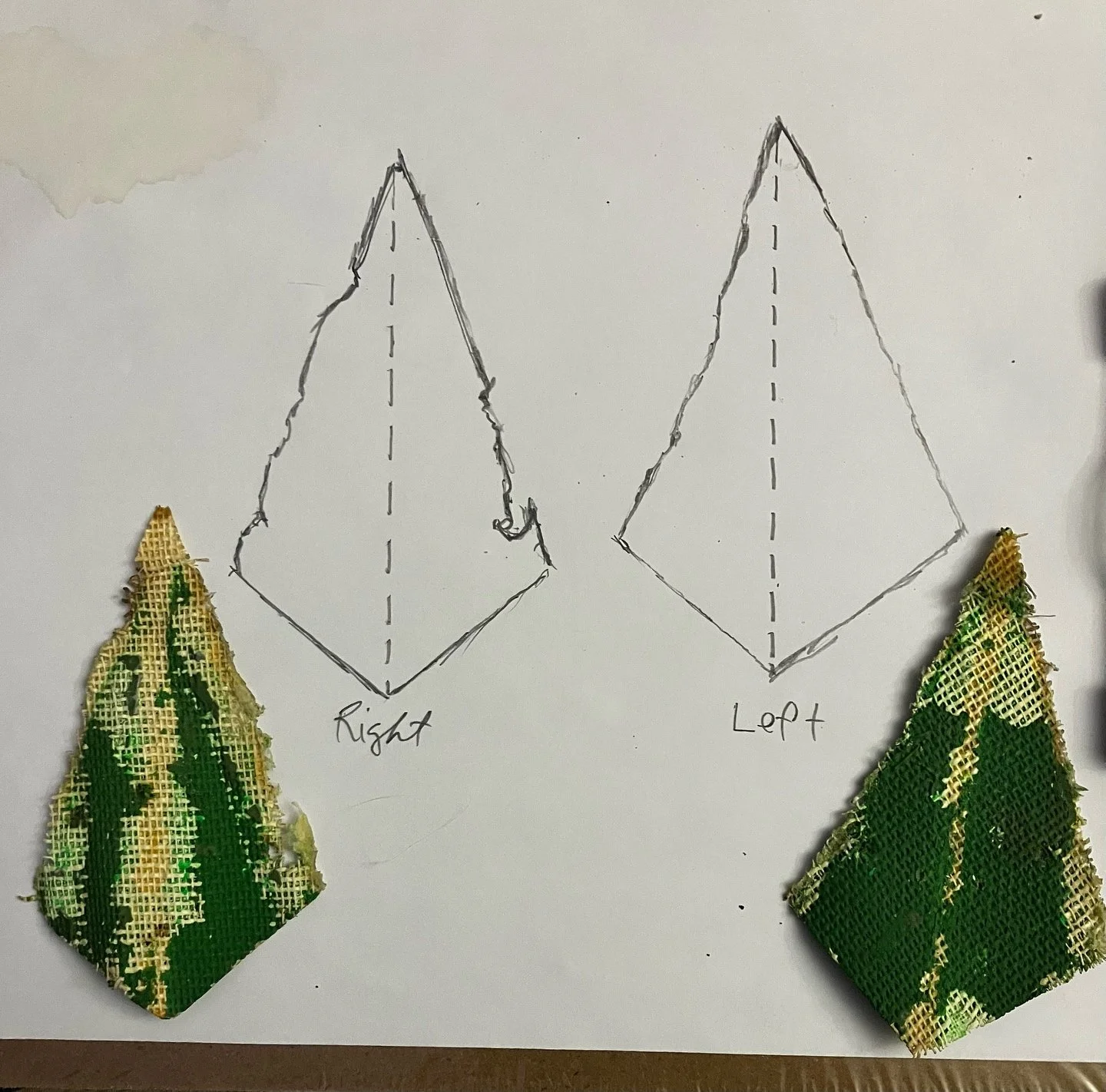
Restoring Ribbert's Feet: The webbing on Ribbert’s feet, found beneath thick globs of bond-o and neon paint, appeared to be original and was made from two layers of bonded painter's canvas. To replicate the webbing, small art canvas boards were obtained, separated from their backing, and dried flat. The pieces were laminated together with mod podge and smoothed with a roller. The original webbing design was sketched, grain lines noted, and shapes plotted on the correct grain before cutting. Once cured, a base coat of paint was applied to the new webbing.
Addressing Dents and Finalizing the Feet: Significant dents in Ribbert’s right leg were filled after applying a sealant to protect the original paint, resulting in an even surface. To attach the new webbing, mod podge was painted on both the webbing and toes, allowed to become tacky, and the webbing was pressed into place and held with clips until dry. Additional mod podge was applied along the seams for extra strength, ensuring a secure and long-lasting restoration.


Paint Prep:
Brush Down: A
Wipe Down: T
Varnish layer: A
Paint Process: To replicate the original base paint:
Base Color: T
Florescent Paint: For a solid layer of color under UV lighting:
T
A
T
Painting the Eyes:
T
T
G
O
Finishing Details:
Body Accents: N
Varnish: N
Costume: (Paying Homage to Vagabond Frog)
M
T
A
Chat with us.